Showing posts with label Knowledge ('Ilm). Show all posts

Tuesday, 25 November 2025

Having Knowledge Is One Thing…


Having Knowledge Is One Thing…

Shaykh ul-Islaam Ibn Taymeeyah [رحمه الله] said:

«وليس كلّ من وجدَ العلم قَدرَ على التعبير عنه، والإحتجاج له ! فالعلم شيءٌ . وبيانه شيءٌ آخر . والمناظرة عنه، وإقامة دليله شيءٌ ثالث . والجواب عن حجّة مخالفهِ شيءٌ رابعٌ .»

❝Not everyone who finds knowledge is capable of expressing it, and using it as evidence.

Therefore, knowledge is one thing and clarifying it is another matter.

Debating about knowledge and establishing the proof is the third matter.

Responding to the evidences of the one who opposes the proof is a fourth matter.❞

[Jawab Al-Itiradaat Al-Misareeyah Ala Al-Futeeyah Al-Hamaweeyah, (Page: 44) | Translated By Abbas Abu Yahya].

Text taken from: https://followingthesunnah.com/having-knowledge-is-one-thing/

[To read this text translated to Spanish Language, click here]


Sunday, 16 November 2025

Affliction to Knowledge & its People


Affliction to Knowledge & its People

Ibn Hazm (رحمه الله) said:

“There is no affliction more harmful to knowledge and its people than intruders into it — those who are not from its true people. They are ignorant yet think they know, they corrupt yet believe they are righteous.”

 [Madaawat al-Nufoos, p. 67].

[To read this text in Spanish Language, click here]


Monday, 13 October 2025

What Prevents A Person From Following The Messenger


What Prevents A Person From

 Following The Messenger


Shaykh ul-Islaam Ibn Taymeeyah [رحمه الله] said:

 «الذي يمنع الإنسان من اتّباع الرّسول صَلّى الله عَليْهِ وسَلّم؛ شيْئانِ: إمّا الجهل ، وإِمّا فساد القصد.»

❝That which prevents a person from following the Messenger [ﷺ] are two matters: either ignorance or either corrupt intent.❞


[Majmoo Al-Fatawa, (15/93) | Translated By Abbas Abu Yahya Miraath Al-Anbiyya]

[To read this text translated to Spanish Language, click here]

Tuesday, 7 October 2025

Seize five things


Seize five things

Ibn Abi Haatim (Rahimahullah) said:

“I entered Damascus and came upon the students of hadeeth, and I passed by the circle of Qasim al-Joo’ee. I found a group sitting around him and he was speaking. Their appearance amazed me; and I heard him saying:


“Seize the benefit of five things from the people of your time:


1) When you are present, you are not known;

2) When you are absent, you are not missed;

3) When you are seen, your advice is not sought;

4) When you say something, your saying is not accepted;

5)When you have some knowledge, you are not given anything for it.


I also advise you with five matters:


1) When you are treated unjustly, do not behave unjustly;

2) When you are praised do not become happy;

3) When you are criticised, do not become upset;

4) When you are not believed, do not become angry;

5) If the people act deceitfully towards you, do not act deceitfully towards them.”


Ibn Abi Hatim said: So I took this as my benefit from Damascus”


[Related by Ibn al-Jawzi (Rahimahullah) in Sifatus-Safwaa (2/200]

[To read this text in Spanish Language, click here].

Taken from: https://salaficentre.com/2014/05/29/reminder-seize-the-benefit-of-five-things-from-the-people-of-your-time/

Sunday, 5 October 2025

Seeking Knowledge at an Older Age


Seeking Knowledge at an Older Age


What would you advise someone who wants to start seeking knowledge at an old age? If he cannot find a scholar to study under, would it benefit him to study without a scholar?

We ask Allah to aid those whom He has honored with an interest in seeking knowledge. However, knowledge within itself is a difficult undertaking that requires great effort. The older a person gets, the larger they become physically, and the weaker their understanding becomes. So someone who is starting to seek knowledge at an old age should choose a trustworthy scholar to study under, because gaining knowledge by way of the scholars saves time. It is better and easier.

It saves time because a scholar is like an encyclopedia of knowledge, especially if he is well-versed in Arabic grammar, Tafseer, Hadeeth, Fiqh and other sciences. So instead of having to read twenty books for instance, he can easily acquire the knowledge within them from a scholar, this is why it saves time.

It is also safer. A person may rely on a book whose author's method contradicts the method of the righteous predecessors, whether in deriving evidence or issuing rulings.

Therefore we advise anyone who wants to seek knowledge at old age to study under a reliable scholar, for this will save him time. You should not despair and say: 'I am too old now', because if do so you would deny yourself knowledge.

It was narrated that a man once entered a Masjid after Dhuhr and sat down, so someone commanded him to get up and perform two Rak'ahs, so he got up and prayed. On another occasion, he entered the Masjid after 'Asr and started to pray two Rak'ahs, a man told him: 'Do not pray now, this is a time when prayers are prohibited.' He then said to himself that he must seek knowledge. He started seeking knowledge until he became an Imam. It was ignorance that drove him to seek knowledge.


Al-Imam Ibn 'Uthaymeen

The Book of Knowledge: p.162

[To read this text translated into Spanish language click here].


طلب العلم على كبر السن

lالإمام ابن عثيمين

كتاب العلم : ص 162

وسئل حفظه الله تعالى: بماذا تنصح من بدأ في طلب العلم على كبر سنه؟ وإن لم يتيسر له شيخ يأخذ منه ويلازمه فهل ينفعه طلب العلم بلا شيخ؟


فأجاب فضيلته بقوله: نسأل الله تعالى أن يعين من أكرمه الله بالاتجاه إلى طلب العلم، ولكن العلم في ذاته صعب يحتاج إلى جهد كبير؛ لأننا نعلم أنه كلما تقدمت السن من الإنسان زاد حجمه وقل فهمه، فهذا الرجل الذي بدأ الآن في طلب العلم ينبغي له أن يختار عالمًا يثق بعلمه ليطلب العلم عليه؛ لأن طلب العلم عن طريق المشايخ أوفر وأقرب وأيسر.


هو أوفر؛ لأن الشيخ عبارة عن موسوعة علمية، لا سيما الذي عنده علم نافع في النحو والتفسير والحديث والفقه وغيره فبدلا من أن يحتاج إلى قراءة عشرين كتابًا يتيسر تحصيله من الشيخ، وهو لذلك يكون أقصر زمنًا.


وهو أقرب للسلامة كذلك؛ لأنه ربما يعتمد على كتاب ويكون نهج مؤلفه مخالفًا لنهج السلف سواء في الاستدلال أو في الأحكام فننصح هذا الرجل الذي يريد طلب العلم على الكبر أن يلزم شيخًا موثوقًا، ويأخذ منه؛ لأن ذلك أوفر له، ولا ييأس، ولا يقول بلغت من الكبر عتيًّا؛ لأنه بذلك يَحرم نفسه من العلم.


وقد ذُكر أن بعض أهل العلم دخل المسجد يومًا بعد صلاة الظهر فجلس، فقال له أحد الناس: قم فصل ركعتين، فقام فصلى ركعتين، وذات يوم دخل المسجد بعد صلاة العصر فكبر ليصلي ركعتين فقال له الرجل: لا تصلِّ فهذا وقت نهي، فقال: لا بد أن أطلب العلم، وبدأ في طلب العلم حتى صار إمامًا، فكان هذا الجهل سببًا لعلمه، وإذا علم الله منك حسن النية ومنَّ عليك بالتوفيق فقد تجمع من العلم الشيء الكثير.

Taken from: https://subulassalaam.com/articles/article.cfm?article_id=311

Thursday, 14 August 2025

FOR HIM IS THE FIRE!


FOR HIM IS THE FIRE!


The sign of knowledge that does not benefit is pride, arrogance, and conceit. Such a person seeks high position and ranking in this world and competes for it. He debates with the scholars with the aim of defeating them, and argues with the foolish with the aim of directing their attention towards him. It is reported from the Prophet, peace and blessing be upon him, that whoever seeks knowledge for this purpose, "for him is the Fire, the Fire!" *


* Ibn Mājah #254 and ibn Hibbān #290 on the authority of Jābir.


Book: The Excellence of Knowledge

By Ibn Rajab Al-Hanbalī

Daar us-Sunnah Publishers

P. 60


[To read this text in Spanish Language, click here]


Monday, 21 July 2025

When the Scholar Talks, and When He is Silent


When the Scholar Talks, and When He is Silent

It is reported that Al-Fuḍayl b. ʿAyyāḍ – Allāh have mercy on him – said:

The true faqīh (scholar) is the one who the fear of Allāh makes talk and the fear of Allāh makes silent. If he speaks it is by the Book and the Sunnah, and if he is silent, it is by the Book and the Sunnah. And if something is confusing to him and unclear, he withholds judgement and refers it back to whoever knows about it.


Ibn Baṭṭah, Ibṭāl Al-Ḥiyal p18, 19.

[ To read this text translated to Spanish Language click here]

Taken from: https://www.sayingsofthesalaf.net/when-the-scholar-talks-and-when-he-is-silent/

Monday, 14 July 2025

THE CONDITION OF THE ISLAMIC SOCIETY DUE TO THE DEATH OF THE SCHOLARS


THE CONDITION OF THE ISLAMIC

 SOCIETY DUE TO 

THE DEATH OF THE SCHOLARS


From the sound narration of the Prophet () that he said:


"Indeed Allah does not remove the knowledge by removing it from the hearts of the people, but he removes the knowledge by the death of the scholars. Until no scholar remains, so the people take the ignorant as their religious leaders, so they will ask them for rulings, and they will give verdicts without knowledge, so they will stray, and lead others astray."


[Bukharī and Muslim]

Book: The Obligation of Verifying News
Sheikh. Dr. Saleh ibn Fawzaan ibn Abdullah al-Fawzaan
Translated by Abdullah Hylton
DuSunnah Publications
P. 66


Monday, 30 June 2025

Imam al Bukhari's Memory


Imam al Bukhari's Memory


Narrated Abū Al-Azhār:

There were around 400 scholars of Hadīth in samarqand, and they all gathered to try cause Muḥammad b. Ismā'il al-Bukhāri to make a mistake.

So, in order to test him, they mixed the chains of sham with the chains of Iraq, and the chains of Iraq with the chains Sham, and the chains of the Haram with the chains of Yemen.

With all of this, they were unable to chase him to make a single mistake.


‎● {هادي الساري صفحة ٥١١}

[To read this text translated into Spanish Language click here]


Thursday, 23 November 2023

Shaykh al Albani's Advice


Shaykh al Albani's Advice


Shaykh Al-Albani said: 

"Make sure that you master the Qur'aan and that you learn something new everyday."


● [Silsilatul Huda wan Noor, 788]

Sunday, 21 August 2022

Ask Allah a Lasting Faith


Ask Allah a Lasting Faith

Mu’āwiyah b. Qurrah reports that Abū Al-Dardā` used to say, “We ask Allāh for a lasting faith (īmān), true certainty and beneficial knowledge.” Mu’āwiyah b. Qurrah then said, “So this indicates that there is a type of faith that does not last, and a type of certainty that is not true, and a type of knowledge that is not beneficial.”

Ibn Battah, Al-Ibānah Al-Kubrā Vol. 2 p498.


Note

The supplication mentioned above is as follows in Arabic:

[To read this text in Spanish language click here]

Text taken from: https://www.sayingsofthesalaf.net/ask-allah-a-lasting-faith/

Friday, 25 February 2022

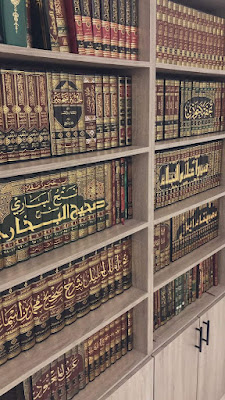
EVERY MUSLIM NEEDS A LIBRARY IN HIS HOME


EVERY MUSLIM NEEDS A LIBRARY

 IN HIS HOME


The reality is that every Muslim needs a library in his home, whether he reads or not. If he reads, then al-hamdulillāh. If he cannot read, then those who can read are many. If someone who can read visits him, then he can request for him to read to him from a book; or someone from his family will grow up to be a male or female reader and they may benefit.


Book: The explanation of “The Book of Knowledge” from Sahīh al-Bukhārī

By Shaykh Zayd al-Madkhalī 

Translated by Raha Batts

P. 53, 54


[To read this text in Spanish language click here].


Tuesday, 28 December 2021

A Flaw In The Seeker Of Knowledge


 A Flaw In The Seeker Of Knowledge 


Shaykh Muhammad Ibn Sālih Al-‘Uthaymīn رحمه الله said:


“Indeed what is pitiful is that you will find some students of knowledge who do not memorise the Qur’ān, moreover, some of them are not even proficient in reading. This is a huge flaw in the methodology of seeking knowledge.”


[Kitāb Ul-‘Ilm, pg.45. @MarkazBukhari]

Monday, 20 December 2021

YOU ARE IN MORE NEED OF KNOWLEDGE THAN FOOD AND DRINK


 YOU ARE IN MORE NEED OF

 KNOWLEDGE THAN FOOD AND DRINK


Imām Ahmad رحمه الله said:


"People are in more need of studying knowledge than they are of food and drink, because a person needs food and drink once or twice a day, but he requires knowledge equivalent to the number of times he breathes."* 


* Ibn al-Qayyim, Madārij al-Sālikīn vol.2 


Book: The Foundations Of The Salafi Da'wah

By Shaykh 'Abdus-Salam bin Burjis

Translated by Rasheed Barbee 

The Salafi Masjid Publications 

P. 20

Monday, 6 December 2021

IF A STUDENT IS TOO PROUD


IF A STUDENT IS TOO PROUD


Imām Ibn Qudāmah al-Maqdīsī said:


"Let him leave his personal opinion for the opinion of his teacher, for a teacher's error benefits the student more than his own correctness."*


(*) The student should show the teacher his mistake with wisdom and fine preaching. This is one of the principles of our monotheistic religion. 


Book: The Inner Secret Of Worship 

By Imām Ibn Qudāmah al-Maqdīsī 

Translated from the original arabic 

Dār as-Sunnah Publishers 

P. 32

KNOWLEDGE OF ALLAAH IS LIGHT


 KNOWLEDGE OF ALLAAH IS LIGHT


Imaam ash-Shaafi'ee (رحمه الله) said,

"I complained to Wakee' about the poorness of my memory. So he directed me to abandon disobedience. And informed me that the knowledge of Allaah is light. And that the light of Allaah is not given to the disobedient."¹


Imaam Maalik said to Imaam ash-Shaafi'ee (رحمه الله), 

"I see that Allaah has placed light in your heart so do not extinguish it with the darkness of disobedience."²


¹ Deewaanush-Shaafi'ee (p.88) refer also to Al-Jawaab al-Kaafee of Ibn Al-Qayyim (p.104).

² Al-Jawaab al-Kaafee of Ibn Al-Qayyim (p.104).


Book: The Path To Guidance

By ibn Qayyim al-Jawziyyah رحمه الله

Translated by Abu 'Iyaad Amjad Rafiq 

Salafi Publications 

P. 53, 54


[To read this text in Spanish Language click here]


Friday, 30 July 2021

Two Appetites Are Never Satisfied


 Two Appetites Are Never Satisfied


قال رسول الله صلى الله عليه وسلم : منهومان لا يشبعان؛ منهوم في علم لا يشبع، ومنهوم في دنيا لا يشبع.


The Messenger of Allāh ﷺ said: “Two hungry ones are NEVER satisfied, the one who is hungry for knowledge is never satisfied and the one hungry for Dunyā (worldly possessions) is never satisfied.”


● [صححه العلامة الألباني في الجامع برقم : ٢٧٦٠ ، ورواه الحاكم في تاريخه]

Saturday, 11 May 2019

The Value of Most People’s Judgements


The Value of Most People’s Judgements

It is reported that Mālik b. Dīnār – Allāh have mercy on him – said:

Since I have come to know people, I do not rejoice when they praise and I do not dislike it when they blame, for those that praise go to excess in praise and those that blame go to excess in blaming. When the scholar learns knowledge in order to act, it humbles him; but if he learns it for something other than action, it only makes him more boastful.

Al-Dhahbī, Siyar ʾAʿlām Al-Nubalāʾ 5:362.


Taken from: https://www.sayingsofthesalaf.net/value-of-most-peoples-judgements/

Friday, 15 February 2019

The Importance of Tolerating the Anger of the Scholar


The Importance of Tolerating 

the Anger of the Scholar


It is reported from Imām Al-Shāfiʿī:

There were two men who used to visit Al-Aʿmash, one who was concerned with ḥadīth and one who was not. One day Al-Aʿmash became angry with the man who studied ḥadīth, so the other said to him, “If he ever got angry with me like he got angry with you I would never go back to him.” To this Al-Aʿmash said, “In that case he would be a fool like you, leaving what benefits him because of my bad character (behaviour).”

Al-Khaṭīb, Al-Jāmiʿ li Akhlāq Al-Rāwī 1:338.


It is also reported from Imām Al-Shāfiʿī:

It was said to Sufyān b. ʿUyaynah, “People come to you from around the world, and [sometimes] you get angry with them? They might depart and leave you.” He replied, “In that case they would be fools like you, leaving what benefits them because of my bad character (behaviour).”

Op. cit. p339.

It is reported that Muʿāfā b. ʿImrān said:

The one who gets angry against a scholar is like someone who gets angry with the pillars of a mosque.

Ibid.

Taken from:  https://www.sayingsofthesalaf.net/the-importance-of-tolerating-the-anger-of-the-scholar/

Thursday, 3 January 2019

A Man Should Sit Where He Benefits


A Man Should Sit Where He Benefits


It is reported that:

ʿAlī b. Ḥusayn – Allāh have mercy on him – would sometimes ride to Makkah and return without entering it (meeting anyone there), and he used to sit with Aslam the freedman of ʿUmar (himself a scholar), so it was said to him, “You leave Quraysh, and instead sit with the slave of Banī ʿAdī!” So he replied, “A man [should] sit where he benefits.”


Al-Dhahabī, Siyar Aʿlām Al-Nubalāʾ 4:388.


It is reported that:

ʿAlī b. Ḥusayn – Allāh have mercy on him – would enter the masjid and cut his way through the people until he would sit in the circle of Zayd b. Aslam. Nāfiʿ b. Jubayr said to him, “Allāh forgive you, you are the sayyid of the people, yet you come traversing the people to sit with this slave.” So ʿAlī b. Ḥusayn replied, “Knowledge is to be sought and come to and looked for wherever it is.”


Ibid.


Translated from Arabic to English by Owais Al-Hashimi

https://www.sayingsofthesalaf.net/a-man-should-sit-where-he-benefits/